
Follow the Trend: Time-Series Momentum for Crypto HODLers
Article

Performance figures are presented for informational purposes only and should be considered in the context of broader portfolio objectives, risk tolerance, and regulatory considerations. Past performance is not indicative of future results.
Crypto investors have been told they have two options: trade actively or HODL and hope.
Active traders rely on short-term moves, often in higher-risk tokens, to achieve financial gain but typically get punished when the market reverses faster than they can react. HODLers on the other hand hold through everything, which sounds disciplined until they’re stuck in a 70% drawdown.
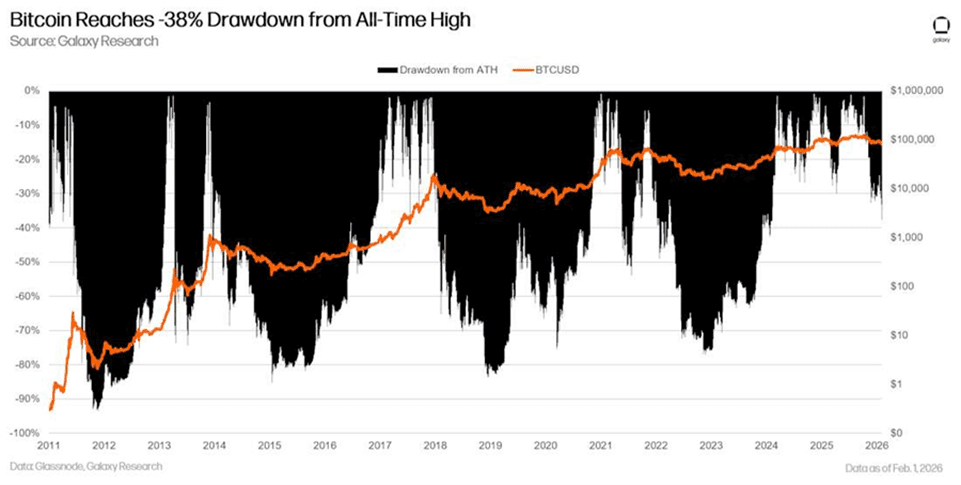
There is a third option however, and institutional investors in traditional finance have been using it for over 30 years.
How Traditional Markets Handle Volatility
For decades, investors in equities, commodities, and fixed income have used a tool known as time-series momentum. The concept is straightforward: instead of holding a fixed position regardless of conditions, you adjust your exposure based on prevailing trends. If the trend is positive, you maintain or increase your position. When the trend weakens or turns negative, you scale down or potentially go short.
The MSCI World Momentum Index is one of the most widely tracked examples of this approach and demonstrates how this form of "trend-following" can provide risk-maintained returns over long periods.
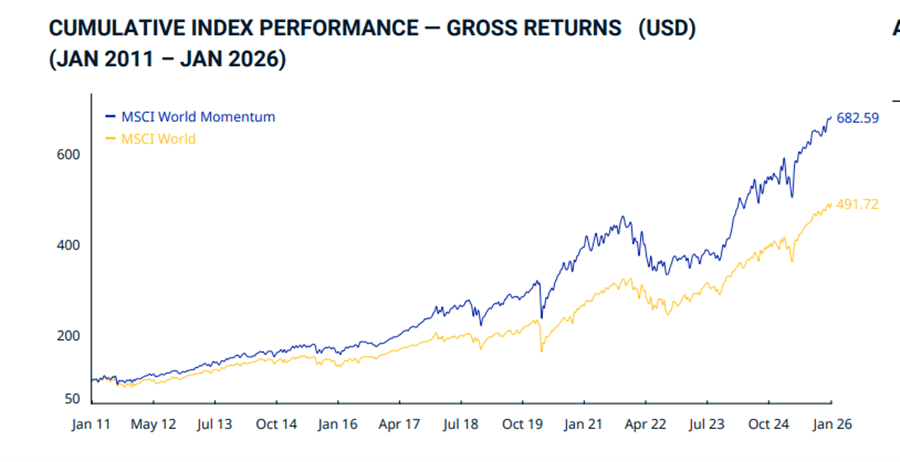
Volatility management is all the more important in an asset class like crypto, where trends in either direction are harder to estimate than almost anything in traditional markets. That in turn makes it a clean fit for momentum-based frameworks.
Why Now?
Over the past year, crypto has matured in ways that hasn't received enough mainstream media acknowledgement. Institutional participation has expanded into spot ETFs and structured products, bringing larger and more persistent capital flows into major digital assets. But exposure management still lags what investors have available to them in every other asset class.
While 88% of crypto investors intend to continue investing in crypto, repeated drawdowns and prolonged recovery periods have reinforced the challenges of HODLing. Time-series momentum offers a way to stay invested when markets are trending higher while being able to respond when the trend changes course.
How TS Momentum Actually Works in Crypto
If the above made intuitive sense, you may still be wondering how does time-series momentum differ from other momentum approaches? Why does it work well in crypto? And what does real performance data look like?
Momentum strategies in traditional markets come in two forms:
Cross-sectional momentum selects assets that have outperformed relative to their peers and shorts or avoids the laggards. In other words, essentially betting on winners staying winners within a group.
Time-series momentum evaluates a single asset's own trend and adjusts exposure accordingly. So if BTC has been trending up, you hold or add. If it's been trending down, the strategy automatically reduces or goes short. In this strategy there’s no comparison between products, so when it comes to crypto, TS momentum has a structural advantage as crypto is a market where fundamental data is inconsistent and cross-asset comparisons are unreliable. Price, often the most dependable data point across major tokens, is all you need.
So, Trade Blue Chips Then?
Major crypto assets trend in sustained, directional moves. In bull markets, they rally persistently as capital flows compound. In bear markets, they drift lower over extended periods as leverage unwinds and risk appetite changes. These are the conditions where crypto diverges from equities and are the same conditions that TS momentum is designed to capture.
In traditional equity momentum, historically much of the premium comes from the short leg and smaller stocks. In crypto, the signal is strongest in the long leg and larger tokens like BTC, ETH, and SOL.
In other words, with small caps and less popular crypto, such as meme coins, you can typically expect sharp pumps followed by quick reversals driven by low liquidity and concentrated ownership. Orderly trends are more rare and thus unreliable, meaning momentum strategies become less useful. Momentum strategies really shine with the reliable, long-term trends we see in crypto blue chips like ETH, regardless of direction.
Real Performance: A CTA-Style Momentum Strategy
To ground this in data, here's what a live TS momentum strategy looks like in practice. This is a CTA-style long/short momentum strategy from one of our partner managers on the HODL platform, with a fully live track record dating back to July 2021:
Sharpe ratio: ~2.37 | Sortino ratio: ~4.24
Cumulative return: ~2.45x since inception | Annualized return: 26.6%
Average annual volatility: ~11.2%
Max drawdown: ~10.1% | Worst month: ~-5.0%
Positive months: ~73% | Positive quarters: ~83%
This strategy was live through the 2022 bear market, the FTX collapse, the choppy recovery that followed, all the way into crypto’s present winter. It saw just a 10% max drawdown during a period that saw BTC fall over 75% from its highs, which shows what systematic risk management can do in practice.
The caveat worth stating is that trend-following strategies can underperform in choppy, range-bound markets and may lag sharp reversals. No strategy works in all environments, but for investors whose alternative is unmanaged long-only exposure, the risk-adjusted profile is worth considering.
How HODL Makes This Accessible
HODL is building non-custodial infrastructure that brings these strategies on-chain. The core architecture uses ERC-4626 and ERC-7540 vault structures that apply discrete, algorithmic trading for trend-following exposure in major blue-chip tokens.
And because these strategies are open source, the signals can be inspected, users can understand how the strategy works, and access the same systematic tools used by quantitative funds. Users have access to self-custody with no lockups, you can enter or exit when you decide.
Beyond momentum, users can combine TS momentum exposure with delta-neutral strategies, long/short frameworks, and other categories launching on the platform. The goal is to provide access to institutional-grade tools in a single non-custodial platform.
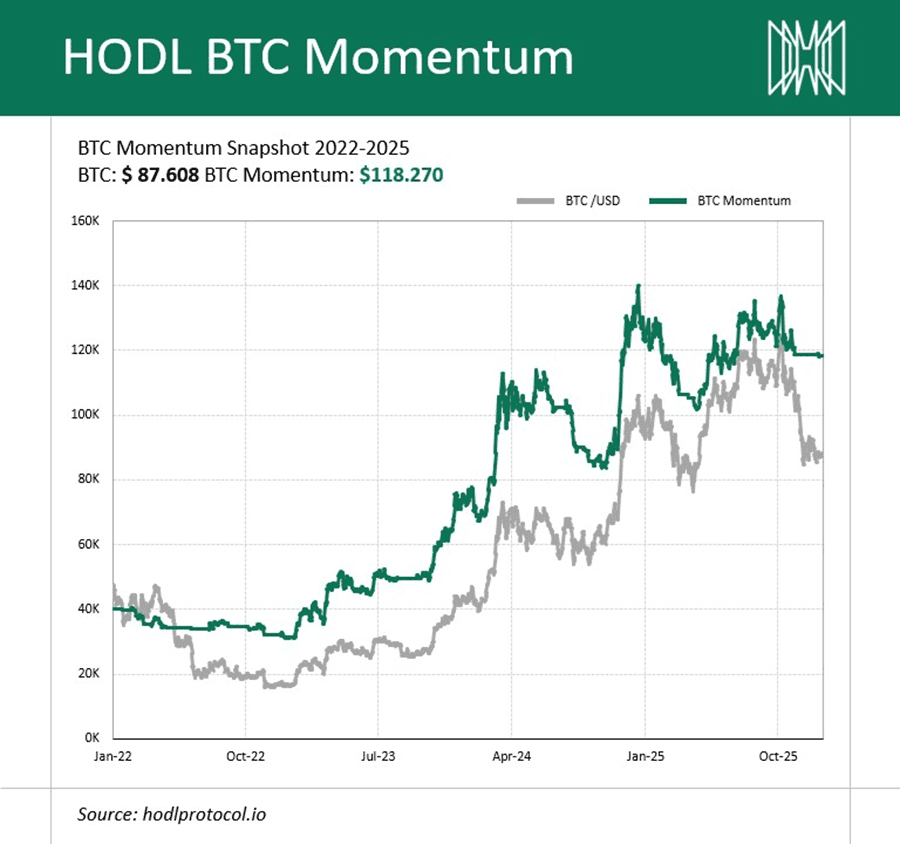
This approach is built for investors who believe in the long-term relevance of major digital assets and are looking to up the sophistication of their trading strategies. The first TS momentum vaults for BTC and ETH are currently in private beta, with additional assets to follow.
**The strategies discussed are offered through third-party managers on the HODL platform. Performance data reflects live track records and is presented net of strategy-level fees unless otherwise noted. Investors should review full disclosures before participating.